When Griefbots Take on the Persona of a Deceased Loved One: Reflections and Research Insights
ge language models are pushing into the space of death and grief, through the development of so-called griefbots, which are chatbots trained on a deceased loved one’s digital footprint (e.g., their messages and texts). Griefbots are primarily designed as tools to support grieving individuals after the loss of a loved one by simulating the deceased loved one’s style of communication, yet there exists little to no empirical research on griefbots.
Longitudinal Virtual Spiritual Care

Many healthcare systems now offer virtual spiritual care to chronically ill patients. These patients, unlike critically ill patients in hospital settings, have no clear discharge date. This leaves it up to chaplains to decide when their care for these patients will end. So far, no clear disciplinary standards have been developed for how or when to end care.
The Baylor Scott & White Health Digital Spiritual Care Team: Expanding Customer Access by Expanding Options
Baylor Scott and White Health’s Office of Mission and Ministry has initiated multiple programs to engage our customers through technology. Our hope is to be able to provide them with high quality spiritual care wherever there is a signal. We will discuss our hybrid inpatient model, 65+ Outpatient Model, Hospital at Home, and services through the myBSWHealth app and the Spiritual Care Support Line.
Integrating Virtual Spiritual Care Across the Cancer Care Continuum
Spiritual care for outpatients with cancer spans a wide and deeply personal journey—from testing and diagnosis through treatment, survivorship, and end of life. Yet many of these individuals spend little time within hospital walls, making connection and continuity of care a growing challenge. Virtual tools now offer chaplains new ways to meet care recipients where they are—both physically and spiritually.
This webinar will explore how Houston Methodist’s Neal Cancer Center developed and implemented an integrated virtual spiritual care program within its outpatient oncology clinics. Using the tools embedded in the EPIC electronic medical record (EMR) system, the program created ways to integrate spiritual care into the scheduling, referrals, documentation, and communication processes of the clinic and allows for ongoing connection with care recipients across the continuum of care.
Digital Technologies and Online Tools in Spiritual Care Education and Training in Nursing, Chaplaincy and Other Healthcare Professions – A Scoping Review
Digital Technologies and Online Tools in Spiritual Care Education and Training in Nursing, Chaplaincy and Other Healthcare Professions: A Scoping Review Download Spirituality and spiritual care are integral to holistic healthcare, requiring collaboration among healthcare and chaplains or other religious professionals. The European Association for Palliative Care highlights the multidimensional nature of spiritual care, with […]
Availability, Usability, and Commercialization of Digital Spiritual Care Educational Resources for Healthcare Professionals: An Exploratory Scoping Review
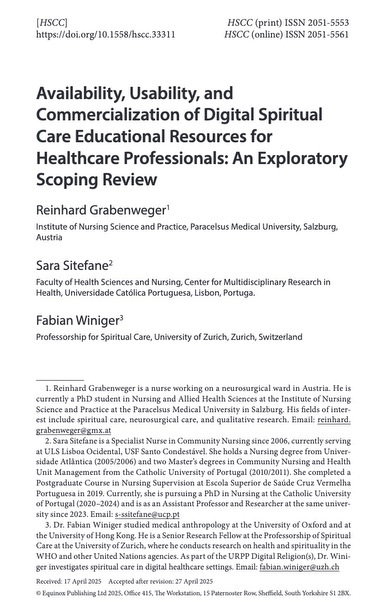
Availability, Usability, and Commercialization of Digital Spiritual Care Educational Resources for Healthcare Professionals: An Exploratory Scoping Review Download International discourse on effective educational practices in spiritual care has highlighted the potential of online programmes to enhance learning and contribute to sustained spiritual care provision. This scoping review aims to map existing digital education resources for […]
Disease Based Telechaplaincy: Supporting Folks with Chronic Illness in a Virtual Setting

For the past year, Rabbi Rebecca Kamil has partnered with the CLL Society (Chronic Lymphocytic Leukemia) to be the chaplain for their clientele.
Acceptability of Digital Spiritual Care: Results from a Mixed-Methods Study in Switzerland

Acceptability of Digital Spiritual Care: Results from a Mixed-Methods Study in Switzerland Download This study aims to, first, measure previous experience with and acceptance of digital spiritual care in a healthcare context, and to identify related sociodemographic characteristics and religious/spiritual factors. Secondly, it explores the reasons related to the acceptability of different models of digital […]
Mercy Virtual Spiritual Care: Empowering Care Recipients to Access Integrated Spiritual Care through Technology

This presentation explores how Mercy Virtual Spiritual Care is leveraging technology to empower over one million care recipients with 24/7 access to integrated spiritual care. Through the MyMercy platform’s “Contact Spiritual Care” functionality, patients can connect with a chaplain in just a few clicks—anytime, anywhere. We will also highlight key Electronic Medical Record (EPIC) customizations that enable spiritual care screening during all inpatient admissions and select ambulatory visits. These innovations reflect Mercy’s commitment to whole-person care by embedding spiritual support seamlessly into the digital and clinical care experience.
Telechaplaincy and Ascension’s “On Demand” Model of Spiritual Care (2/2)

In this webinar, we will share how Ascension is seeking to address the needs of patients in the outpatient and ambulatory setting, through the development of digitally enabled programs and strategies to identify and articulate spiritual issues and concerns within the setting of Population Health.